





I arrived at Husna’s school around 10am, unsure of what to expect. My supervisor at HOST International Malaysia had informed me that Husna ran a school for Rohingya and Burmese refugees in Kuala Lumpur, where students are taught from pre-school to Grade 5 according to the Malaysian education syllabus. I was given an address that led to a convenience store, and upon my arrival, a student fetched me up to the school.
The school was tucked away beside a mamak store, up several flights of stairs and marked out only by a humble sign above the doorway. “PUSAT PENDIDIKAN MUHAJIRIN ROHINGYA PERKIM,” it wrote.
As an intern at HOST, a non-profit dedicated to serving the refugee community in Malaysia, I had hoped to find avenues to best apply my writing skills.
“I’ll write a story,” I told my supervisor. “Let me interview someone, or shadow a notable figure, or work with the community – anything.”
“I have someone in mind,” he replied. “She runs a school.”
The student held the door for me, and I walked in.
“GOOD MORNING CIKGU!” the students greeted. They had mistaken me for a new teacher. Ranging in age from four to thirteen, students in the preschool class fidgeted in their seats, almost unable to contain the effervescence of their youth.
Surprised by their enthusiasm, I returned their greeting and hesitated, unsure of where to place myself unobtrusively. I stood out, not just in my appearance, but also my foreignness to Malaysia and this school. Sure, my home country of Singapore isn’t that far away, but my inability to speak Malay placed further distance between myself and these students.
I was relieved when a student rushed forward with a chair for me at the back of the class.
Husna, as both principal and teacher at the school, taught English and Mathematics. 10am was Mathematics class. She conducted her class informally and affectionately, sitting cross-legged as students crowded around her, clamouring for her attention. She was well-liked, and I saw little in the way of lecture-style lessons. Instead, though the class contained almost sixty students, Husna dotingly individualised her teaching to each student that came up to her.
I watched as Husna guided a student’s hand to connect the dots.
“Tiga, empat, lima…”
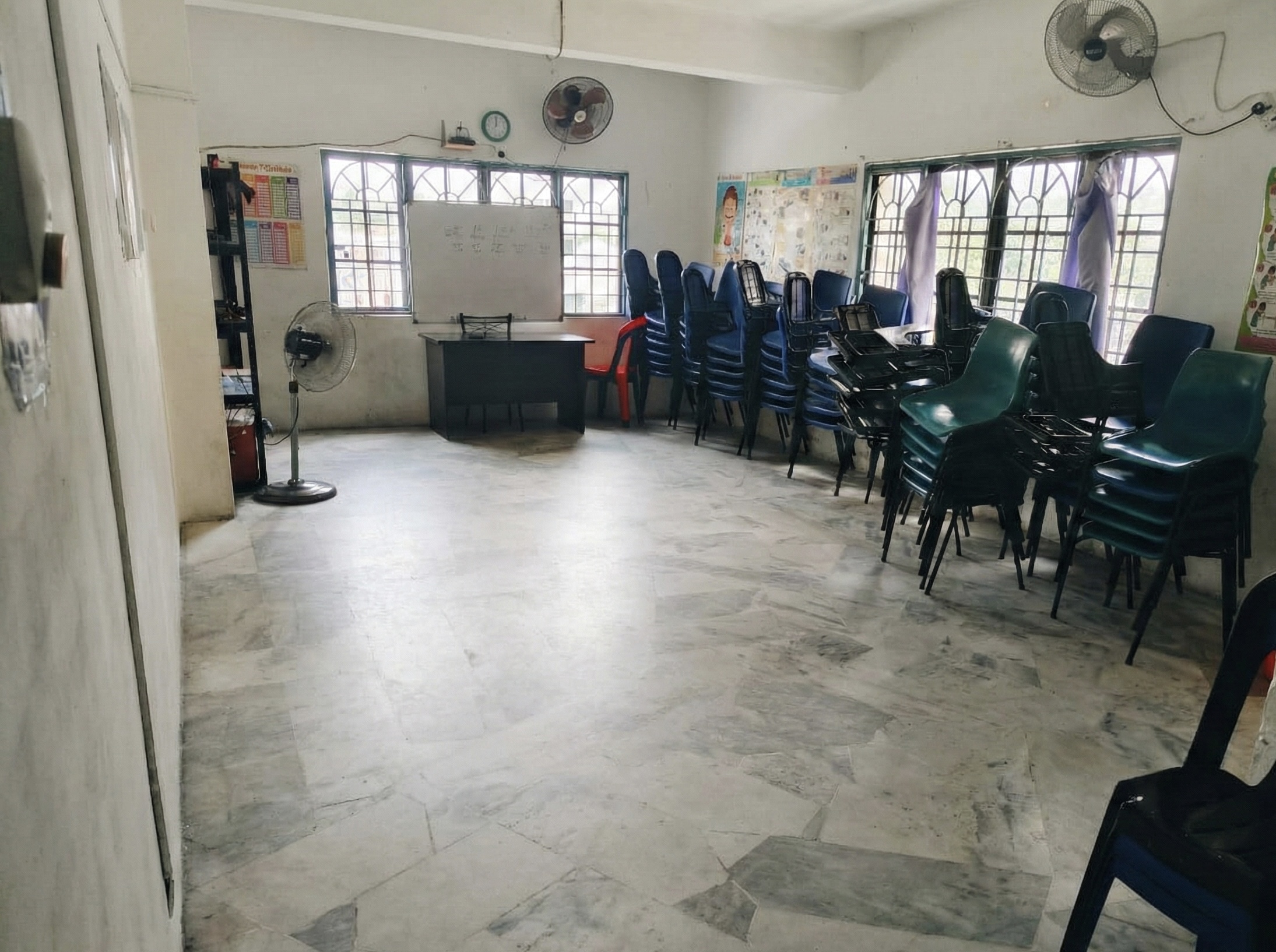
Thirteen-year-olds learning to count. Sparse posters in English, Malay and Arabic, illuminated by sunlight filtered through dusty windows. A steady stream of chatter.
Lunchtime was around 11.45am. Once dismissed, the students began packing up the chairs in the classroom. Some swept the floor, others stacked chairs. The older boys took on the brunt of the work, though Husna chastised them for the ruckus they made as they dragged chairs across the floor.
Husna and I sat and ate in the girls’ room.
“My granddaughter,” she told me, gesturing to a girl who looked to be 4 or 5 years old. Not her biological granddaughter, I learnt, but the child of a girl she used to teach.
I noted that Husna looked too young to be teaching multiple generations of students.
“Child marriage,” Husna reminded me.
True enough, after the girls and boys were separated into different rooms, there seemed to be no more than 20 girls in the school, most of them extremely young. More than once, Husna would lament that the girls were often withdrawn from school upon reaching puberty.
“I had one girl, she reached puberty at nine years old,” said Husna. “Too young.”
Typically, Husna informed me, when the girls have their first period, their parents take them out of school and wed them off a few years later.
“18 and above for marriage is okay,” Husna remarked. “Under 18, too young.”
Sometimes, Husna would be successful in persuading parents to keep their girls in school. But not often.
Funded by a Malaysian non-profit organisation, the school first opened in 2009 under Husna’s father-in-law. However, the NGO’s funding is limited. Though they guarantee the salary of Husna, the cook, and the religious teacher, and cover rental and food costs, the salaries of the other two teachers and other upkeep expenses rely on students’ school fees, and parents cannot always afford to pay it. In fact, the school is clearly over-capacity, and though Husna wants to hire another teacher, footing the salary of another teacher is beyond the school’s limited finances.
Perhaps, you might say, Husna could simply stop accepting new students. Resources are already strained. But consider a refugee family that shows up on Husna’s doorstep to register, having scraped together the barest earnings to buy their child a uniform and a bag. How could Husna turn them away? The school represents hope for these children, she believes, and depriving these children of this hope is something that she simply cannot bring herself to do.
Like her students, Husna does not have a MyKad, her parents having come from Myanmar as refugees. Through valiant resilience, the support of her family and her community and sheer luck, she was able to obtain a basic education, then chose to join the school in 2014 as its first female teacher.
She took over from her father-in-law in 2023, becoming the school’s first female principal. Upon taking over, she decided to reregister the school as a private education institution instead of a madrasah. To her, education was the priority. She would teach her students to count and write, empower them beyond daily readings of the Quran.
Husna is strong, I noted. She is atypical in the refugee community, particularly for her status as a working stateless woman giving back to her community. She rejects the notion that the Rohingya women should be carted off at marriage, forced to stay home and out of public life.
And even then, despite being born and raised in Malaysia, despite her education, despite her ability to work and contribute as a woman, she is a refugee, sidelined and invisible. She had come from nothing, became something, and despite a something-ness she is still nothing to Malaysia.
Come prayer time, prayer mats were laid in rows, and the girls lined up facing West.
Muslim or Buddhist, refugee or Malaysian, one trait of children is that they cannot keep still. They fidgeted throughout their prayers, swaying and bouncing as they chanted the verses so familiar to them.
At 2pm, I sat in one of the adjunct classrooms to observe Husna’s next mathematics lesson. The insufficient number of teachers meant that the class consisted of both Grade 5 and Grade 1 students, Husna dividing her attention between the two, and the insufficient number of lecture chairs meant that the Grade 1 students sat on flimsier plastic ones around a single table.
Chairs, according to Husna, are a persistent problem. Students, as children inclined toward mischief or clumsiness, broke them often, at a rate that Husna did not have the funds to replace.
Often, students simply do not show up to school, not because they do not want to, no, their love for school was clear, but because their family needs them to work.
“Why?” the students would protest every Raya and school holiday. “Why can’t we come to school?” Even new students would rarely cry, seeming to take well to Husna and her school.
By 2.45pm, the students began to pack up. Again, chairs were stacked and the floor was swept. Some chose to change their clothes before heading home, others remained in their uniforms that had become increasingly unkempt as the day passed.
The students trickled out. The room was then empty, save two children.
“My kids,” said Husna, and this time I was more certain that they were her biological children.
She handed them RM10 and told them to go buy themselves some snacks.
Husna led me into her office, the only air-conditioned room in the school. Several children’s drawings were hung up on the walls – drawings of the Malaysian, Selangor and Burmese flags, one of the Palestinian flag, and one drawing of the school.
“Sekolah,” it wrote across the roof of the school. Three stick figures were depicted, smiling.
It was nearing 3pm, and I sat down for a final chat with Husna.
I asked her, “Are there times when there are students you can’t help? How do you cope with that stress?”
There was an orphan she used to teach. He was fourteen, and often missed school since his guardians wanted to him to work. Husna would cajole and persuade them to send him to school, but his absences persisted, even on examination dates.
The student would disappear late into the night, hanging out with individuals of dubious character and identity. His brother had a glue sniffing habit and had passed away shortly before, and Husna feared that her student would walk down the same path.
So, with hers and her family’s own money, Husna sent the boy off to boarding school, where he would be watched and looked after.
Yes, she said, there are times when she cannot help. But she will try, so, so hard.
Still, Husna’s work is, at times, rewarding. Her favourite day of the year is Teacher’s Day, when she is bombarded with handmade gifts and well-wishes from her students.
“And is there anything you’d like to say to Malaysians who might be reading this story?”
“Maybe to say, they are children, and they are in need, and they have right to get education. Maybe, if cannot in formal, then they can be in informal education. This school is informal, we don’t have any formal exam. At least we give them a chance to read and write, you know? We don’t want anything big, you know, like, how to say…”
I looked up from furiously scribbling in my notebook. “Like a big university, big facilities?”
“Yes, don’t need big university, just to get some basic education. Because, they are humans, right? They deserve education. I want to give them education.”
The air-conditioning emitted a low hum, a vague mid-afternoon fatigue creeping into my bones. It was 4.30pm, and I began to worry about the peak hour heavy traffic so typical in KL.
“Thank you, Husna,” I said, “For showing me around your school today and for sharing so much with me.”
“Of course!” she answered.
Our parting was brief. I had booked a Grab, and, briefly pondering the 15RM I would spend on ride-hailing instead of a 4RM bus ride and the positionality I possessed to be able to do so, I rushed down to meet my driver.
I hope Husna’s school will continue to thrive. It is a lifeline for so many, a refuge for the refugee. I hope her students make it somewhere in life, wherever that may be. And knowing that Husna and so many others like her have it in their heart to help the most vulnerable of their community, I feel the tiniest ounce of hope for the future of refugees in Malaysia.